
In this article, I will break down Cosmos DB vs MongoDB across architectural foundations, consistency models, performance benchmarks, pricing structures, and developer experience to help you make the right engineering decision for your stack.
Cosmos DB vs MongoDB
Architectural Foundations: Native Multi-Model vs Dedicated Document Store
To understand how each database behaves under load, we must first look at how their underlying engines are built.
Azure Cosmos DB
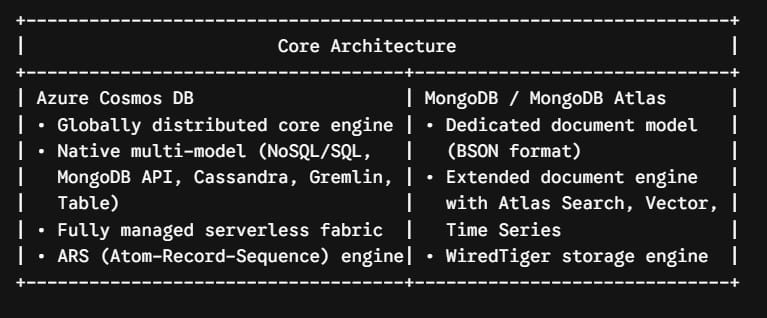
Azure Cosmos DB was built from the ground up by Microsoft as a globally distributed, horizontally partitioned database service. Internally, Cosmos DB uses an Atom-Record-Sequence (ARS) storage engine.
Instead of being tied exclusively to documents, the core engine converts data into an abstract type system. Microsoft then exposes this engine via multiple API interfaces:
- NoSQL API (formerly Core/SQL API): The native interface supporting JSON documents queried via SQL syntax.
- API for MongoDB: Emulates the MongoDB wire protocol, allowing teams to use native MongoDB client drivers against a Cosmos DB backend.
- Apache Cassandra, Gremlin, and Azure Table APIs: Providing wire-level compatibility for wide-column, graph, and key-value paradigms.
Cosmos DB is designed as a true multi-tenant, cloud-native resource governed by strictly allocated resource units.
MongoDB
MongoDB stores data in BSON (Binary JSON), an optimized binary serialization format that supports rich data types like Date, Decimal128, and raw binary buffers.
Unlike Cosmos DB’s multi-API wrapper design, MongoDB’s architecture centers around the WiredTiger storage engine, fine-tuned for high-throughput document manipulation, complex embedded hierarchies, and rich in-memory caching.
MongoDB Atlas extends this engine with native operational plugins:
- Atlas Search: Powered by Apache Lucene for native full-text search without needing external Elasticsearch clusters.
- Atlas Vector Search: Integrated semantic search capabilities for AI and Retrieval-Augmented Generation (RAG) pipelines.
- Time Series Collections: Optimized bucketed storage for IoT and metrics workloads.
High-Level Comparison
Here is an architectural snapshot comparing the core capabilities of both platforms:
| Feature Dimension | Azure Cosmos DB | MongoDB (Atlas / Self-Managed) |
| Primary Data Model | Multi-model (Document, Key-Value, Graph, Wide-Column) | Document (JSON/BSON) |
| Native Query Language | SQL dialect (NoSQL API) or API-specific syntax | MongoDB Query API (MQL) & Aggregation Pipeline |
| Hosting Model | Proprietary to Microsoft Azure | Multi-Cloud (AWS, Azure, GCP) & On-Premises |
| Scalability Mechanism | Automatic horizontal partitioning via Partition Keys | Horizontal Sharding via Shard Keys & Config Servers |
| Consistency Models | 5 tunable consistency levels | Tunable Read/Write Concerns (Causal Consistency) |
| Throughput Metric | Request Units per second (RU/s) | Compute Tiers (RAM/vCPU), IOPS, & Shards |
| Multi-Region Writes | Active-Active multi-region writes supported natively | Primary-Secondary replication (Global Clusters available) |
| SLA Guarantees | Five 9s (99.999%) for latency, availability, throughput | Up to 99.995% availability on dedicated Atlas tiers |
Data Modeling and Query Capabilities
The way your developers interact with data daily is a major factor in team velocity and long-term maintainability.
Querying: SQL Dialect vs Aggregation Framework
If your engineering team has a deep background in relational databases, Cosmos DB’s NoSQL API feels immediately familiar. You query nested JSON objects using standard ANSI-SQL-like constructs:
SQL
-- Cosmos DB SQL Query Pattern
SELECT c.id, c.customerName, c.shippingAddress.city
FROM c
WHERE c.status = 'Processed' AND c.orderTotal > 250.00
ORDER BY c.orderTotal DESC
In contrast, MongoDB utilizes the MongoDB Query Language (MQL) and the Aggregation Pipeline. While MQL has a steeper initial learning curve for SQL veterans, its pipeline syntax provides expressive data transformation, multi-stage filtering, grouping, window functions, and array manipulation directly in the database layer:
JSON
// MongoDB Aggregation Pipeline Pattern
[
  { "$match": { "status": "Processed", "orderTotal": { "$gt": 250.00 } } },
  { "$sort": { "orderTotal": -1 } },
  { "$project": { "id": 1, "customerName": 1, "city": "$shippingAddress.city" } }
]
Indexing Strategies
- Cosmos DB Automatic Indexing: By default, Cosmos DB automatically indexes every property path in every JSON document without requiring explicit schema definitions or secondary index creation. While convenient during early development, indexing every path consumes extra Request Units (RU/s) on writes. In production, I always recommend tuning the indexing policy to exclude unused scalar and array paths.
- MongoDB Intentional Indexing: MongoDB requires explicit index definitions (e.g., compound, multikey, text, geospatial, and wildcard indexes). This requires more upfront planning from data engineers, but it offers granular control over write overhead and index memory footprints in the WiredTiger cache.
Consistency Models: Predictability vs Granular Control
Distributed data stores must balance consistency, availability, and partition tolerance (the CAP theorem). How Cosmos DB and MongoDB handle this balance represents one of their starkest architectural contrasts.
Cosmos DB 5 Consistency Levels:
[Strong] ---> [Bounded Staleness] ---> [Session] ---> [Consistent Prefix] ---> [Eventual]
(High Consistency / Higher Latency)              (Low Latency / High Availability)
Cosmos DB’s Five Well-Defined Levels
Microsoft avoids the traditional binary choice between “Strong” and “Eventual” consistency by providing five well-defined, mathematically backed consistency levels:
- Strong: Linearizable reads. Guarantees that readers always see the latest committed write. Multi-region latency is highest in this mode.
- Bounded Staleness: Reads lag behind writes by a user-configured threshold of either time (e.g., 5 seconds) or update versions (e.g., 100 updates).
- Session (Default): Guarantees monotonic reads, monotonic writes, and read-your-own-writes within a single client session token. This is the sweet spot for the vast majority of web applications.
- Consistent Prefix: Ensures that updates are never seen out of order, though data may be stale.
- Eventual: Out-of-order, stale reads are possible until replicas fully converge. Provides the lowest read latency and highest throughput.
MongoDB’s Read and Write Concerns
MongoDB manages consistency dynamically per operation through Read Concerns and Write Concerns:
- Write Concerns (
w: 1,w: "majority",j: true): Dictates whether an acknowledgment is sent after writing to the primary memory, persisting to the on-disk journal, or replicating to a majority of secondary replica set members. - Read Concerns (
local,available,majority,linearizable,snapshot): Determines data isolation levels.linearizablemirrors Cosmos DB’s Strong consistency, whilesnapshotenables ACID multi-document transactions across distributed shards. - Causal Consistency: When enabled in client sessions, MongoDB guarantees read-your-own-writes and monotonic reads, similar to Cosmos DB’s Session consistency.
Global Distribution and Scalability Mechanics
When your workload spans multiple geographic markets—such as serving users simultaneously in California, Texas, and Virginia—replication mechanisms become paramount.
Azure Cosmos DB: Turnkey Active-Active Multi-Write
Cosmos DB allows you to add or remove geographic Azure regions with a few clicks or infrastructure-as-code updates.
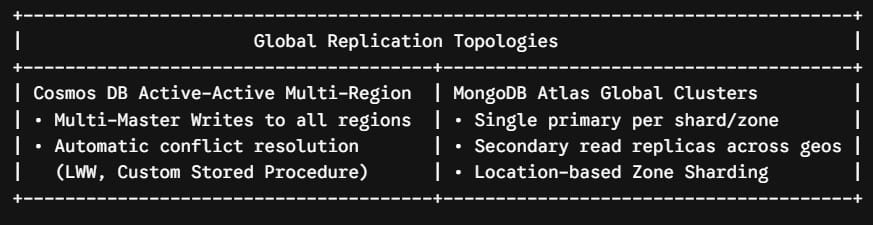
- Multi-Region Writes: Cosmos DB allows active write operations in every replicated region simultaneously.
- Conflict Resolution: Because concurrent writes can occur in different continents on the same document, Cosmos DB provides built-in conflict resolution policies, including Last-Write-Wins (LWW) based on system timestamps, or custom conflict resolution procedures written in JavaScript.
- Partition Key Architecture: Data is automatically divided into logical partitions based on your selected Partition Key, and mapped dynamically across physical partitions managed entirely by the Azure fabric.
MongoDB: Primary-Secondary Replica Sets and Zone Sharding
MongoDB’s fundamental high-availability unit is the Replica Set (typically 3 or more nodes across availability zones), operating on an elected primary model:
- Single-Master Writes: In standard replica sets, all write operations flow through the elected primary node. Reads can be routed to secondary nodes using read preferences (
primaryPreferred,secondary,nearest). - Global Clusters & Zone Sharding: For multi-region architectures, MongoDB Atlas offers Global Clusters. By configuring Zone Sharding, you can pin specific documents to shards residing in specific geographic regions based on a country or region key. This provides localized low-latency reads and writes while helping enterprises comply with data sovereignty regulations.
Performance, Throughput, and Capacity Planning
Performance in both databases is fundamentally tied to how capacity is provisioned and governed.
Cosmos DB Request Units (RU/s)
Cosmos DB abstracts CPU, memory, and IOPS into a single normalized rate-limiting currency called a Request Unit (RU):
- Reading a 1 KB document using its unique ID and partition key costs roughly 1 RU.
- Writing, updating, or querying complex indexed properties costs significantly more RUs depending on payload size and query complexity.
Cosmos DB offers two capacity models:
- Provisioned Throughput (Standard or Autoscale): You reserve a dedicated throughput baseline (e.g., 4,000 to 40,000 RU/s). If your application exceeds this threshold within a given second, Cosmos DB returns an HTTP 429 (Too Many Requests) error, requiring client-side backoff and retry handling.
- Serverless: Ideal for sporadic, low-traffic workloads where you pay purely per consumed RU rather than maintaining hourly reservations.
MongoDB Resource Provisioning (Compute & IOPS)
MongoDB Atlas uses standard infrastructure tiers (e.g., M10, M30, M80 clusters) mapped directly to dedicated virtual machines with defined vCPU, RAM, storage size, and provisioned IOPS:
- There is no artificial rate-limiting per second via 429 errors. If your query traffic spikes, CPU utilization increases and latency degrades gracefully rather than hard-failing requests.
- Optimization focuses on traditional database tuning: index coverage, working set memory residency (keeping indexes and active data in RAM), and connection pooling.
Ecosystem, Tooling, and Cloud Lock-In
Azure Ecosystem Integration
If your enterprise is deeply invested in Microsoft technologies, Cosmos DB integrates cleanly with the broader Azure landscape:
- Azure Synapse Link: Allows analytical queries directly on Cosmos DB operational data without ETL pipelines via HTAP (Hybrid Transactional/Analytical Processing).
- Azure Functions: Native event-driven triggers via the Cosmos DB Change Feed make building reactive microservices straightforward.
- Security & Governance: Built-in integration with Microsoft Entra ID (formerly Azure AD), Azure Key Vault, and role-based access control (RBAC).
MongoDB’s Multi-Cloud and Developer Ecosystem
MongoDB’s primary strategic advantage is cloud independence:
- True Portability: Run MongoDB on AWS, Google Cloud Platform (GCP), Microsoft Azure, or on-premises in private data centers using the exact same drivers and operational code.
- Atlas Multi-Cloud Clusters: A single MongoDB Atlas cluster can span multiple cloud providers simultaneously (e.g., replicating data across AWS and Azure for extreme disaster recovery).
- Developer Mindshare: The ubiquitous MQL syntax, supported by tools like MongoDB Compass, Mongo Shell (
mongosh), and extensive ORMs/ODMs (Mongoose, Spring Data MongoDB, PyMongo), ensures broad developer familiarity across hiring pipelines.
Decision Matrix: When to Choose Which
Choose Azure Cosmos DB If:
- Your infrastructure is hosted on Microsoft Azure: You want native, single-pane-of-glass integration with Azure IAM, Event Hubs, and Synapse.
- You need turnkey multi-region active-active writes: Your application requires write capabilities across multiple global regions with automated conflict resolution.
- SLA-backed latency guarantees are mandatory: You require strict, financially backed SLAs covering sub-10ms read/write latencies at the 99th percentile.
- You prefer a standardized SQL query syntax: Your engineers want to query document models using SQL constructs without learning MQL.
Choose MongoDB / MongoDB Atlas If:
- Cloud neutrality and multi-cloud deployment are required: You must avoid single-provider lock-in or need to deploy across AWS, GCP, and on-premises environments.
- You require advanced analytics and aggregation: Your workloads rely heavily on complex data pipelines, array unwinding, facet lookups, and multi-stage transformations.
- You need built-in Full-Text Search or Vector Search: You want integrated Lucene-based search or semantic search capabilities without maintaining separate search infrastructure.
- You want familiar hardware-based capacity planning: Your operations team prefers managing CPU, memory, and IOPS headroom over calibrating Request Units (RUs).
Technical Evaluation Summary
Both Azure Cosmos DB and MongoDB represent the gold standard of modern distributed NoSQL systems.
If your organization is committed to the Azure cloud and demands active-active global distribution with strict SLA guarantees, Cosmos DB provides an unmatched managed infrastructure fabric. If your focus is developer expressiveness, complex data manipulation, rich indexing versatility, and long-term cloud portability, MongoDB Atlas remains the premier document data platform in modern software engineering.
You may also like the following articles:

I am Rajkishore, and I am a Microsoft Certified IT Consultant. I have over 14 years of experience in Microsoft Azure and AWS, with good experience in Azure Functions, Storage, Virtual Machines, Logic Apps, PowerShell Commands, CLI Commands, Machine Learning, AI, Azure Cognitive Services, DevOps, etc. Not only that, I do have good real-time experience in designing and developing cloud-native data integrations on Azure or AWS, etc. I hope you will learn from these practical Azure tutorials. Read more.