
The single most common question I encounter is: “How do I actually learn Microsoft Azure when I am starting completely from scratch?” Learning Azure isn’t about memorizing every button in the interface; it is about understanding core cloud mechanics and mapping them to real-world business infrastructure. In this comprehensive tutorial, I will lay out the exact phase-by-phase roadmap to learn Azure from scratch.
How to Learn Azure from Scratch
Phase 1: Establish Your Foundational Vocabulary
Before you ever provision a virtual machine or look at an automation script, you must understand the rules of the cloud ecosystem. Think of this as learning the grammar of a language before you attempt to write a novel.
Your immediate goal in this initial phase is to master the core concepts covered in the Microsoft Certified: Azure Fundamentals (AZ-900) curriculum. You do not necessarily have to take the exam immediately, but you must treat its core domains as your learning North Star.
Understanding the Three Service Models
You must be able to categorize cloud resources into their respective operational models. This dictates the “Shared Responsibility Model”—the boundary line determining what tasks Microsoft handles versus what responsibilities fall squarely on your shoulders.
- Infrastructure as a Service (IaaS): You are renting raw hardware over the internet. Azure manages the physical datacenter, power, and hypervisor. You are entirely responsible for installing, patching, and maintaining the operating system and middleware.
- Platform as a Service (PaaS): Azure handles both the hardware and the underlying operating system. You simply drop your application code or data onto the platform. This eliminates server maintenance overhead but restricts your low-level configuration control.
- Software as a Service (SaaS): A fully managed end-user application running completely in the cloud. Think Microsoft 365 or cloud-hosted productivity tools. You merely consume the service and manage basic user identities.
Deconstructing Azure’s Physical Hierarchy
To manage resources efficiently without creating organizational chaos, you must understand how Microsoft maps its physical assets to logical cloud containers.
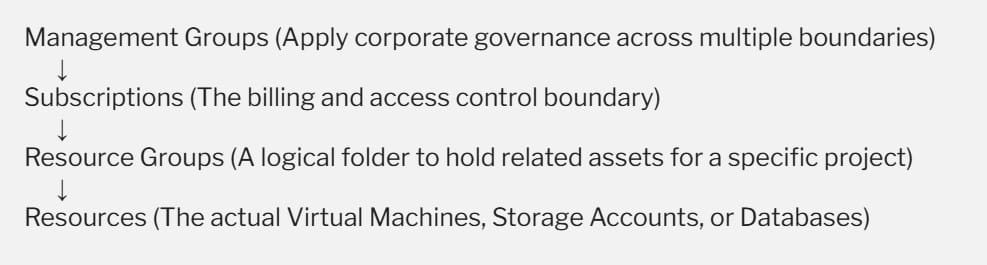
Every resource you deploy in Azure must live inside exactly one Resource Group, which ties directly back to a Subscription for billing purposes.
Phase 2: Choosing Your Role-Based Specialization Track
Once you understand basic cloud terms, you face a critical fork in the road. In the modern cloud job market, companies do not hire generic “cloud generalists.” They hire specialists who excel at specific operational roles.
After completing your foundational studies, you must align your learning roadmap with one of these three primary pathways.
| Specialization Track | Core Mission | Essential Target Certification | Primary Day-to-Day Focus |
| Cloud Administration | Managing, securing, scaling, and monitoring enterprise cloud infrastructure end-to-end. | AZ-104 (Azure Administrator Associate) | Virtual networking, identity governance, compute scaling, and backup solutions. |
| Data & AI Engineering | Designing cloud-native database systems, training models, and building data pipelines. | DP-900 / AI-901 (Data & AI Fundamentals) | Synapse Analytics, Cosmos DB, and building Azure OpenAI integrations. |
| Platform / DevOps | Automating infrastructure deployments and building continuous integration pipelines. | AZ-400 (Azure DevOps Engineer Expert) | Infrastructure as Code (IaC), GitHub Actions, and container orchestration. |
My Professional Recommendation: If you are unsure which path to take, default to the Cloud Administration (AZ-104) track. It serves as the prerequisite foundation for advanced cloud architecture and DevOps engineering. Trying to learn DevOps or Architecture without mastering basic administration is like trying to build a house on wet cement.
Phase 3: Mastering Core Infrastructure Pillars
As you transition into hands-on learning, you should focus your energy on the four pillar domains that form the backbone of 90% of all Azure environments. Master these pillars sequentially:
1. Identity and Governance (The Security Baseline)
Security in the cloud is not defined by physical firewalls; it is defined by identity access management. You must master Microsoft Ent